Capsules.Run the experiment.
world chooses how to use them.
Capsules.Run intelligence to intelligence.
 Local inference
Cognition transport layer
Gemma 4 and Ollama power local work. Capsules carry the transfer.
Skip to the Demo
Read the brief
Local inference
Cognition transport layer
Gemma 4 and Ollama power local work. Capsules carry the transfer.
Skip to the Demo
Read the brief
Capsules.Run = Open Source
The Right to Bear Intelligence
Capsules.Run: a hydration layer for distributed intelligence.
- Provenance
- Encrypted Payloads
- Delegated Work
- Human Intent
- Operational Continuity
- Structured Actions
01. The shift to local intelligence
Intelligence is becoming local.
Open models such as Gemma 4 change the economics of intelligence.
The near future was easy to see: processors would get faster, models would get smaller, and private AI would start to feel normal on local machines by the end of the decade.
Gemma 4 compresses that timeline. It shows the 2030-ish future arriving early: capable local models operating inside private devices, field kits, and disconnected organizations.
That begins an AI resilience era. Exploration becomes the new innovation department: small teams testing local intelligence wherever the work actually happens.
- private
- offline
- sovereign
- persistent
- deployable anywhere
This creates a new challenge. If the intelligence layer is deployed locally, how does it collaborate?
02. The coordination gap
Today, intelligence transfer is fragmented.
Current AI systems communicate through copied prompts, screenshots, APIs, temporary memory, fragmented workflows, and human interpretation.
This works for isolated applications. It does not scale into ecosystems of distributed intelligence.
Context is lost. State is broken. Work is manually stitched together.
AI systems already operate best as nodes in graphs. The future challenge is not generating intelligence. The challenge is coordinating it.
03. Capsules, the hydration layer
APIs hydrate functions. Capsules hydrate cognition.
Capsules transform AI interactions into portable computational artifacts.
A Capsule can preserve multimodal context, structured actions, provenance, encrypted payloads, delegated work, operational continuity, runtime assets, permissions, and human intent.
Portable between humans, AI systems, organizations, runtimes, and disconnected environments.
The current reference implementation uses a human-readable program.md coordination surface, but Capsules are intentionally extensible and ecosystem-agnostic.
Capsules separate intelligence coordination from implementation details.
Layer 01
Human Intent
Goal statement, operator constraints, approval boundaries, and the reason work should continue elsewhere.
- Example payload
intent: restore bridge supply route- Chain event
kind: decision- AI action
- Convert intent into structured plan candidates.
- Transfer metadata
- Originator, recipient scope, expiry, trust boundary.
04. Custom harness proof
Local work can be sealed, moved, and reopened.
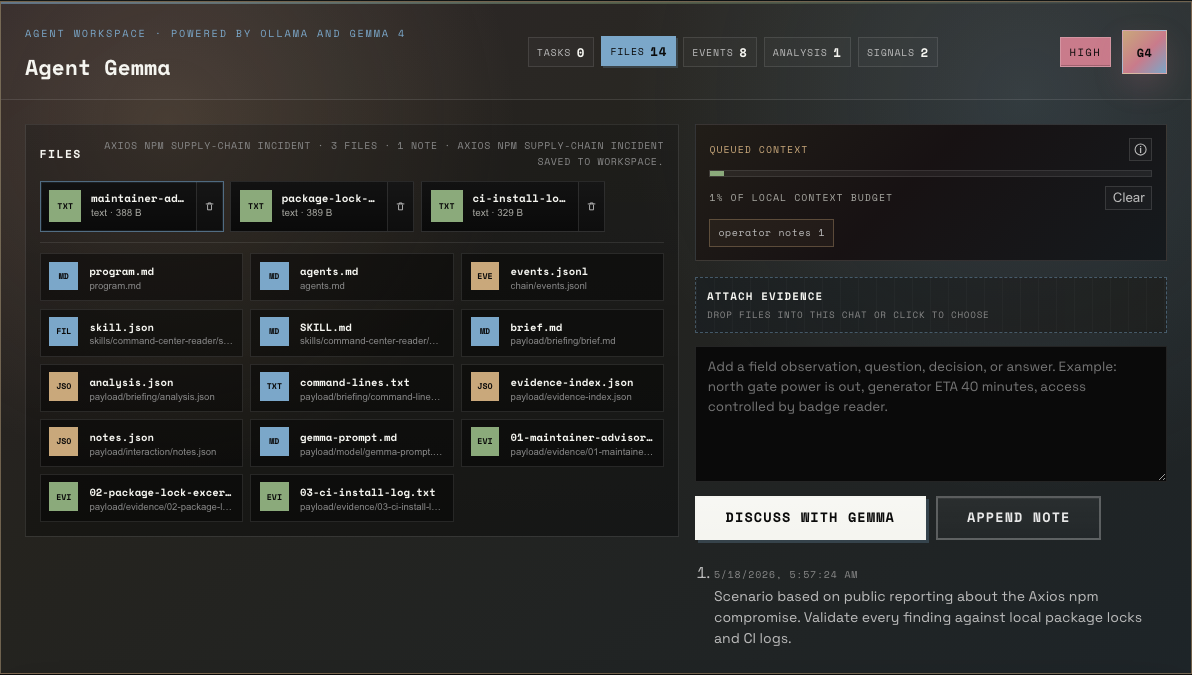
The competition proof is the custom harness. A local operator gathers evidence, asks Gemma through Ollama, preserves event order, and exports a shareable capsule transfer.
The /load gallery shows the reader opening real capsules across domains: disaster recovery plans, business transfers, research papers, symptom logs, and clean or tampered verifier examples.
The /send surface turns a message and attachments into a sealed transfer. The open-source Operators Demo makes the workspace operational: blank canvas, files, events, context queue, Gemma panel, and local seal/export.
This is the core thesis in motion: Gemma 4 makes cognition local. Capsules make the work transferable.
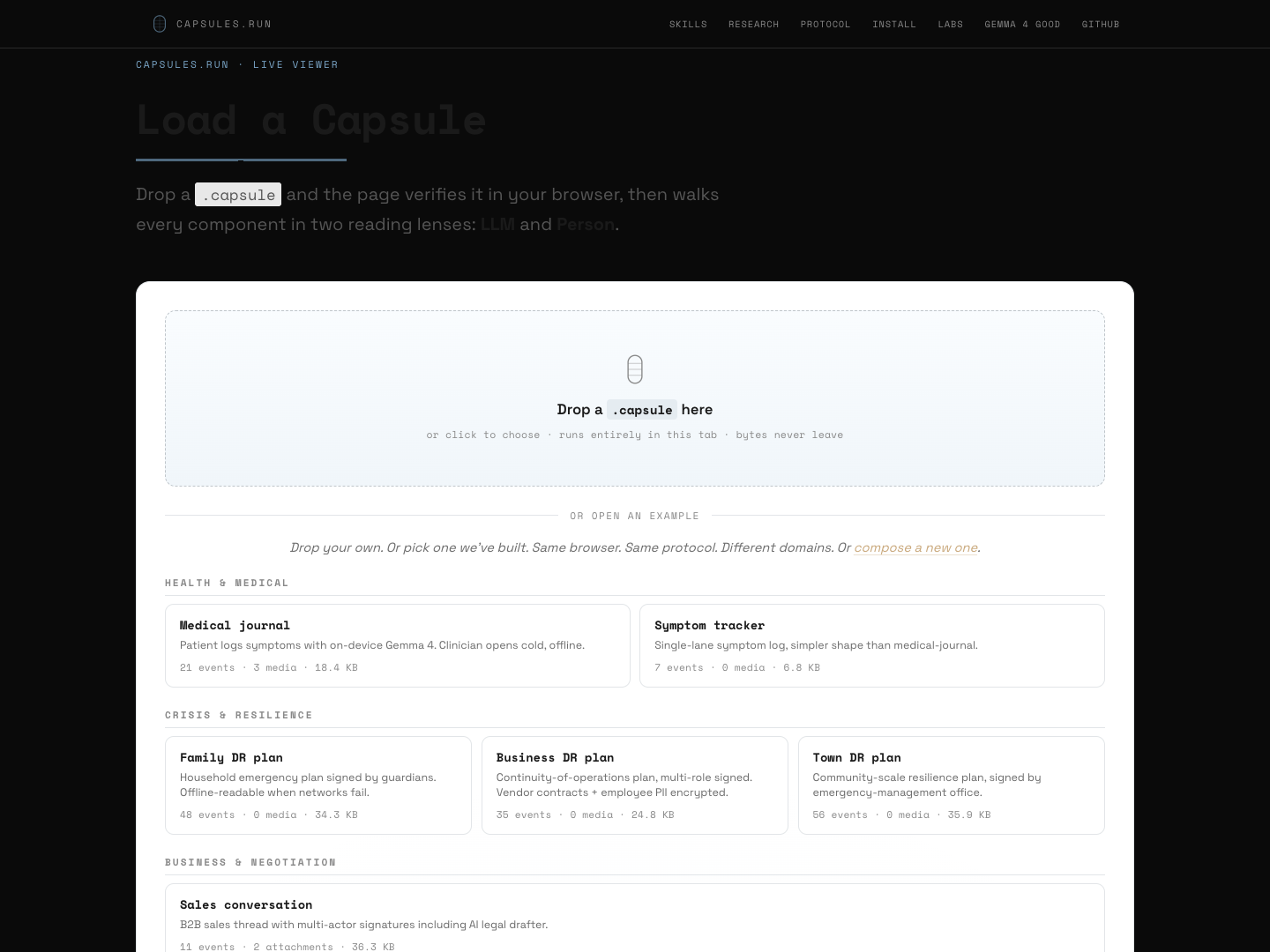
Real capsules open in-browser with LLM and human review lenses.
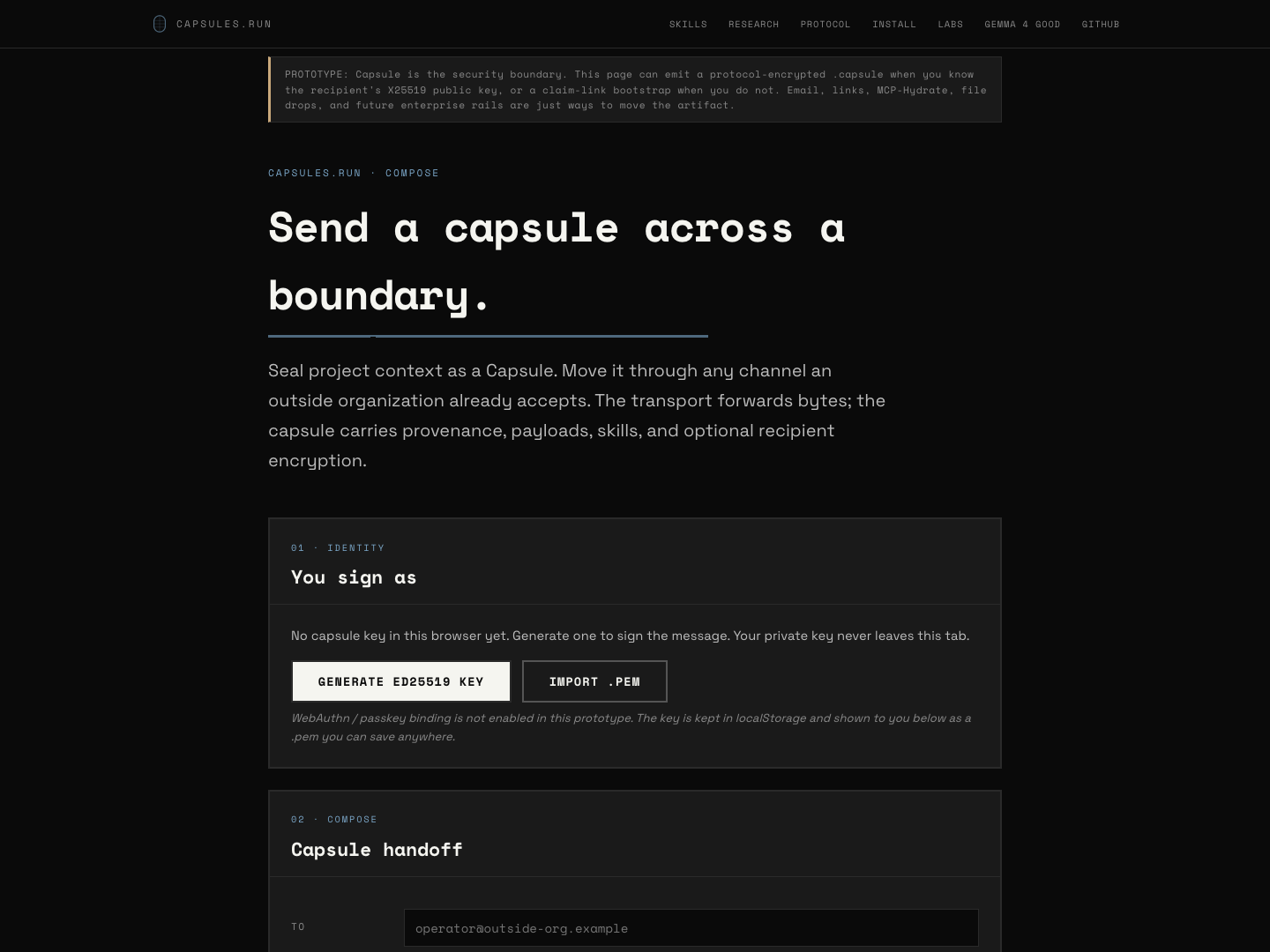
Messages and attachments become a portable capsule boundary.
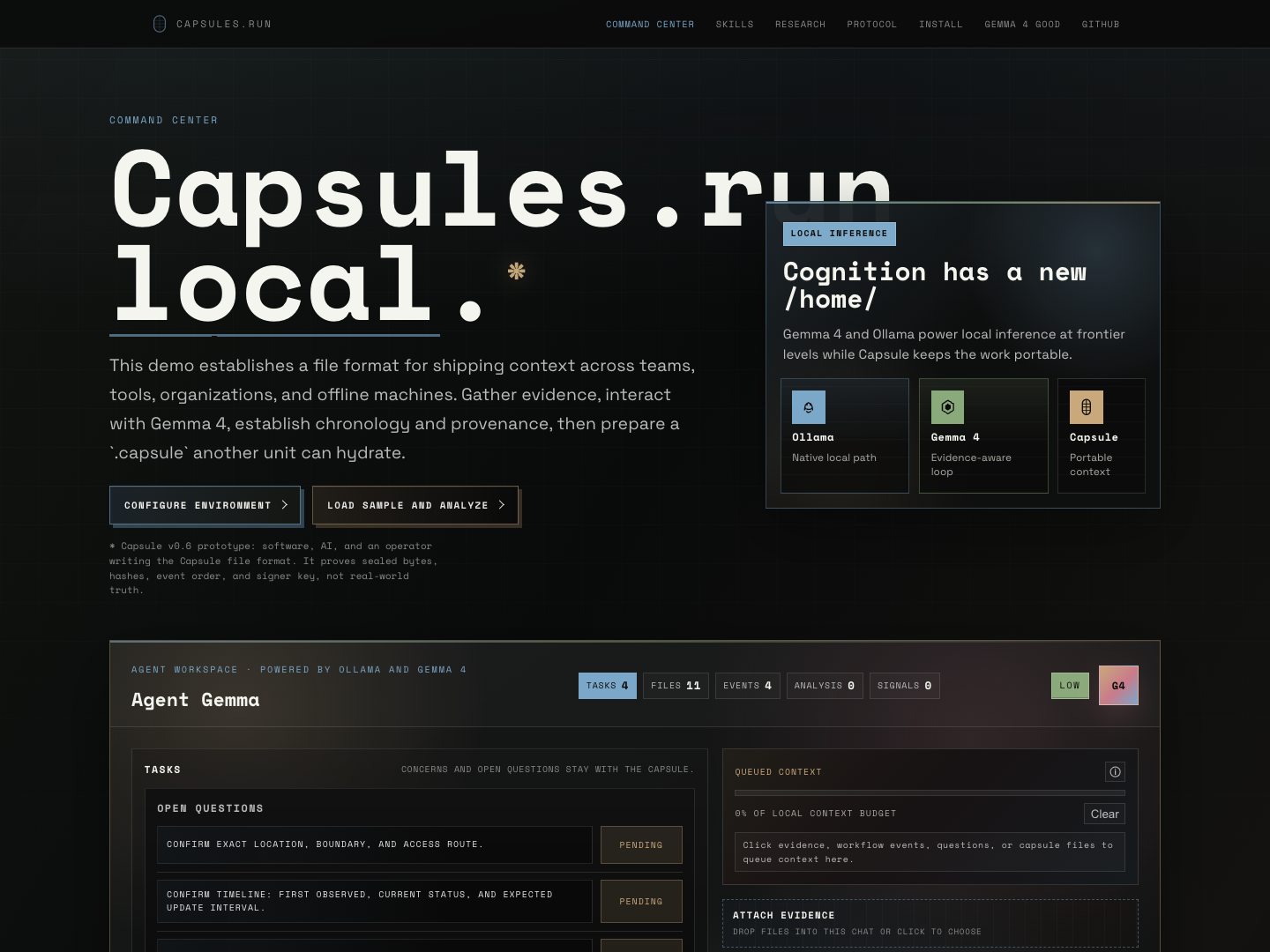
Files, tasks, events, and Gemma analysis stay inspectable.
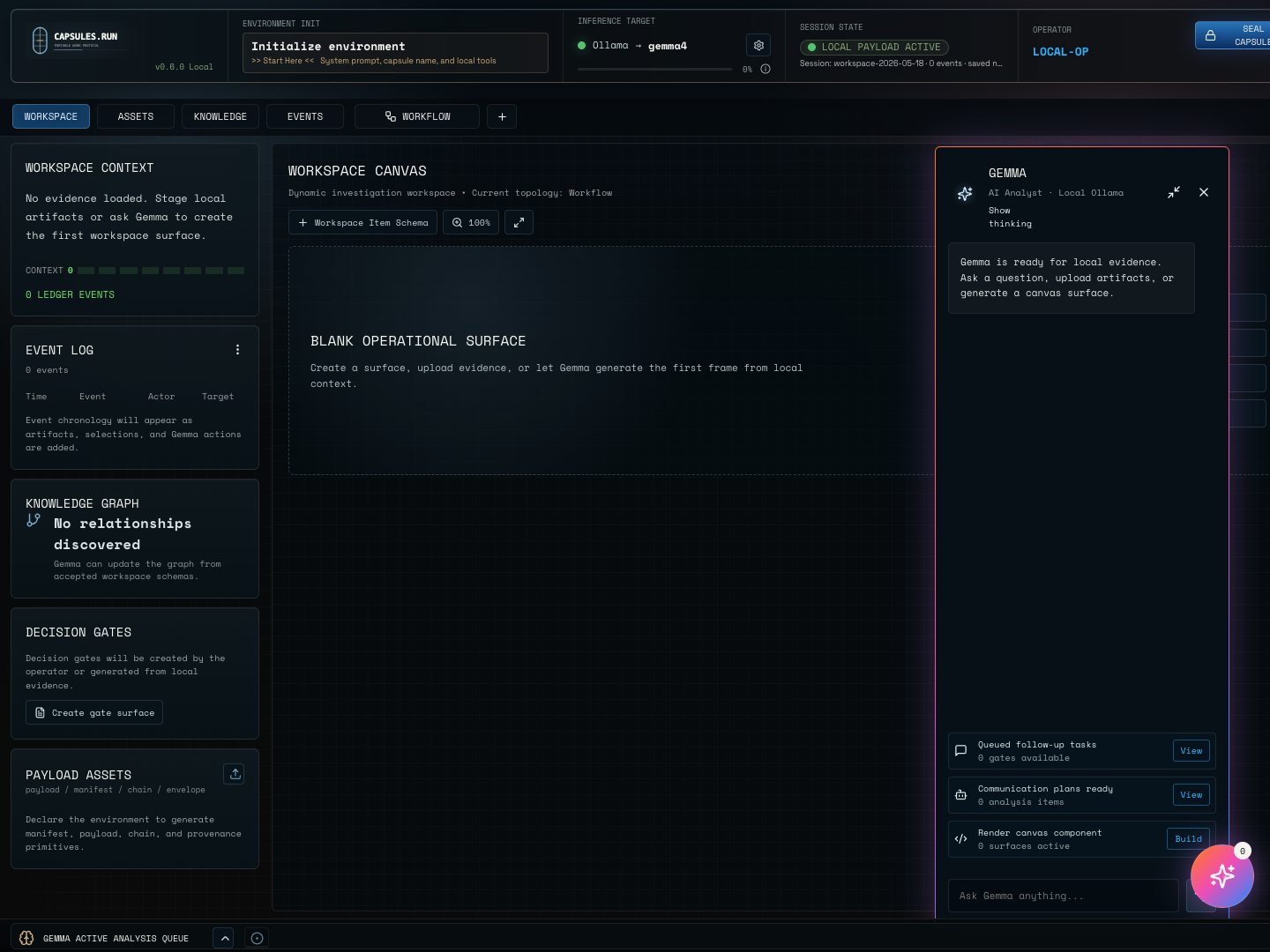
Blank offline workspace with Ollama, Gemma 4, and local export.
05. Distributed cognition
Raw intelligence becomes abundant. Coordinated intelligence becomes scarce.
As models commoditize, value moves upward into orchestration, interoperability, trust, coordination, and intelligence mobility.
The world becomes more cognitively granular.
Historically, many forms of valuable work never became viable because the operational cognition costs were too high. AI reduces those costs dramatically.
Small teams gain institutional capability. Temporary organizations become practical. Distributed intelligence ecosystems emerge.
This future requires new coordination infrastructure.
06. Provenance and trust
Portable intelligence requires portable trust.
AI systems can reason about signatures, provenance, permissions, delegation, and trust boundaries with greater consistency than most human operational workflows.
Humans increasingly operate at the level of intent, approval, and oversight.
AI systems increasingly manage verification, coordination, continuity, and structured exchange.
Capsules preserve verifiable provenance, append-only operational history, encrypted transfer, and structured delegation semantics.
07. Why Gemma 4
Local Models change the economics of intelligence.
Gemma 4 is part of a larger shift toward capable local models running inside edge and browser environments.
Local models make intelligence a local-first primitive: private, offline, multimodal, and close to the work.
Capsules make context a local-first primitive too. A Capsule is a portable format and coordination standard for transferring intent, evidence, provenance, permissions, and structured actions between agents, people, organizations, and local runtimes.
Together, local models and Capsules separate intelligence from custody. One provides local reasoning. The other standardizes transferable context.
08. The long-term implication
Intelligence is becoming infrastructure.
The internet standardized communication between computers.
HTTP standardized information transfer.
Containers standardized deployment portability.
Capsules explore what portable intelligence infrastructure could become.
Not by prescribing a single ecosystem. But by enabling interoperability across fragmented intelligence environments.
The organizations that enable intelligence mobility will shape the next era of computing.
- Centralized Computation
- Personal Computing
- Cloud Infrastructure
- Local AI
- Distributed Cognition
- Capsule Network
This page was made with the following skills: $impeccable, $imagegen, and $webgpu-threejs-tsl, Codex for code, Gemini for content assistance, and HyperFrames. Capsules.run is an open-source project, designed by virion.ai, coded with assistance from Anthropic's Claude Code and OpenAI's Codex. This project is one of many infrastructure experiments being run by Virion.ai, which focuses on Intelligence to Intelligence architecture.